If you’ve just finished your 12th boards and you’re the kid who filled every notebook margin with doodles, you’ve probably already typed “animation course in Kolkata” into Google more than once. Good news: you’re asking the right question at the right time. The animation and VFX industry in India isn’t a niche hobby field anymore — it’s a fast-growing, job-creating industry, and Kolkata has quietly become one of the eastern hubs for it.
But here’s the catch. Search for animation institutes in Kolkata and you’ll find dozens of options — certificate programs, diplomas, a BSc in Animation, and design degrees — all claiming to be the “best.” Picking the wrong one wastes a year and a chunk of your family’s savings. Picking the right one sets up an entire career.
This guide breaks down exactly how to evaluate an animation institute, what a genuine BSc in Animation actually involves, what fees to expect, and the mistakes most students make before they even sit for a counselling session.
Table of Contents
What Choosing the “Right” Animation Course Really Means
An animation course is a structured, skill-based program that trains students in drawing, storytelling, character design, 2D/3D animation software, and visual effects, so they can build a portfolio strong enough to get hired by studios, gaming companies, or ad agencies.
Choosing the “right” one isn’t about picking the institute with the flashiest advertisement. It’s about matching three things: your learning goal (job-ready skill vs. a formal degree), your budget, and the quality of mentorship and industry exposure you’ll actually get. A course that looks identical on a brochure can produce completely different outcomes depending on who’s teaching it and how much hands-on studio-style practice is built into it.
Why Animation Is a Smart Career Choice in 2026
Numbers help more than opinions here. India’s Animation and VFX segment is projected to grow from roughly USD 1.3 billion in 2023 to about USD 2.2 billion by 2026, growing at a CAGR of around 17.5%, which makes it the fastest-growing major VFX market globally. That growth isn’t just theoretical — the AVGC-XR sector already makes up close to 20% of India’s entire media and entertainment industry, and a large share of that work now comes from international studios outsourcing to Indian VFX and animation houses for projects tied to Hollywood, Netflix, and Amazon.
What does this mean for a student in Kolkata specifically? It means the work doesn’t need to happen in Mumbai or Hyderabad anymore. Remote pipelines, freelance compositing work, and small-to-mid studios are opening up across Tier-2 cities, and Kolkata’s growing base of design and gaming studios is part of that shift. The sector is also expected to add over 160,000 new jobs annually, with a total of about 20 lakh new jobs anticipated by 2030 — a genuine hiring wave, not a slow trickle.
Types of Animation Courses After 12th
Before comparing institutes, you need to know what kind of course you’re actually shopping for. Broadly, there are four levels.
Certificate Courses
Short, focused programs (usually 3–12 months) that teach one specific skill — say, 2D character animation or motion graphics. Good for someone who wants a quick skill add-on, not a full career pivot.
Diploma in Animation
A more complete program, typically running 1 to 2 years, covering fundamentals of design, 2D/3D animation, and often a specialization like VFX or game art. This is the most popular route among students who want to start working within a year or two.
BSc in Animation
A full undergraduate degree, generally a three-year program combining animation and multimedia theory with practical software training — think Adobe Animate, Autodesk Maya, Blender, and After Effects. This route suits students who want a recognized degree alongside deep technical training, especially if higher studies (MSc, MDes) are part of the long-term plan.
BDes in Animation
A design-focused undergraduate degree that leans more into visual storytelling, sketching, and conceptual design than pure software mastery. It suits students who see themselves as art directors or concept artists rather than technical animators.
Quick comparison:
| Course Type | Duration | Focus | Best For |
|---|---|---|---|
| Certificate | 3–12 months | One specific software/skill | Quick upskilling |
| Diploma in Animation | 1–2 years | 2D/3D animation, VFX basics | Fast entry into the workforce |
| BSc in Animation | 3 years | Animation + multimedia + software | Degree + deep technical skill |
| BDes in Animation | 3–4 years | Design, storytelling, concept art | Aspiring art directors/designers |
Eligibility Criteria for Animation Courses in Kolkata
Most institutes keep the entry bar accessible on purpose, since animation rewards creativity more than a specific academic background.
- You need to have passed 12th (or an equivalent exam) from a recognized board.
- Most BSc in Animation and diploma programs accept students from any stream — Science, Arts, or Commerce.
- A minimum of 45–50% marks in 12th is a common (though not universal) requirement.
- A basic sense of sketching, composition, or visual storytelling is a strong advantage, though most institutes teach these from scratch.
Some design-focused degree programs at the national level require entrance exams like NID’s DAT or NIFT’s entrance test, but most standalone animation training institutes, including career-focused ones in Kolkata, admit students through portfolio review or a simple aptitude interaction rather than a formal exam.
8 Factors to Consider Before Choosing an Animation Course in Kolkata
Here’s where most students go wrong — they compare institutes on price alone. Price matters, but it’s the fourth or fifth factor, not the first.
1. Curriculum depth, not just course length. A one-year diploma with real production-pipeline training can teach you more than a three-year degree that’s stuck on theory. Ask for a semester-wise breakdown before enrolling.
2. Software taught vs. software used in studios today. If a course is still teaching outdated 2D tools without touching industry-standard software like Maya, Blender, or Toon Boom Harmony, that’s a red flag.
3. Faculty with real industry background. A teacher who has actually worked on a production pipeline — not just taught theory for years — brings feedback that mirrors what a studio would say.
4. Portfolio and showreel support. Studios hire on showreels, not certificates. Check whether the institute actively helps you build a portfolio during the course, not just at the end.
5. Placement assistance and industry tie-ups. Ask for the names of studios or companies past students actually joined — not a generic “100% placement” claim.
6. Class size and lab access. Animation is a hands-on craft. Overcrowded batches with limited workstation time slow down skill-building significantly.
7. Fee structure transparency. Confirm whether software licenses, project materials, and certification exam fees are included or charged separately.
8. Location and commute. For an 18–25-year-old balancing college or part-time work, a Kolkata-based institute that’s actually commutable daily matters more than people admit — it directly affects attendance and consistency.
Animation Course Fees in Kolkata
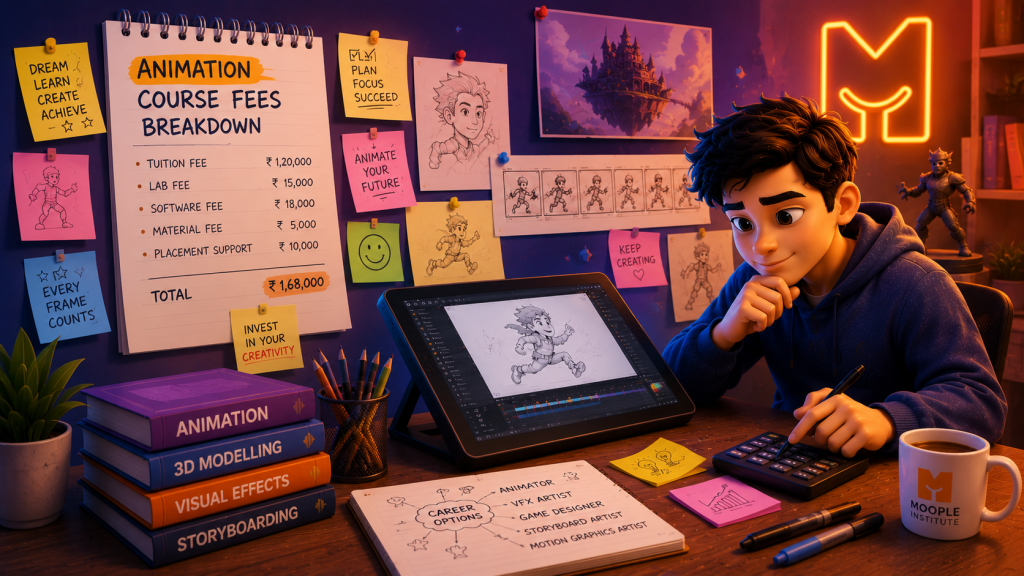
Animation course fees in Kolkata vary quite a bit depending on the course level and institute reputation. As a general reference point across India, average annual fees for animation courses after 12th typically range between roughly INR 1,25,000 and INR 5,00,000, though shorter diploma and certificate programs can cost significantly less.
Here’s a realistic city-level breakdown to use while comparing quotes:
- Certificate courses: Roughly ₹15,000–₹60,000 for the full program, depending on specialization.
- Diploma in Animation: Typically ₹60,000–₹2,00,000 for the full 1–2 year program.
- BSc in Animation (3-year degree): Usually ₹1,50,000–₹4,50,000 across the full course, depending on the institute and included software licenses.
A useful rule of thumb: if a quoted fee looks unusually low compared to everything above, ask exactly what’s excluded — software access, project material, and industry certification exams are common hidden add-ons.
👉 Know More – Animation Course Fees in Kolkata: Complete Guide
Common Mistakes Students Make When Choosing an Animation Institute
Even bright, motivated students trip up on the same few things every admission season.
Chasing the cheapest option without checking curriculum depth is the most common one — it often means outdated software training and no real portfolio support. A close second is ignoring faculty background entirely, since a course is only as good as the person running the lab session. Many students also skip visiting the actual campus or asking to sit in on a demo class, relying instead on a glossy prospectus. And a surprising number never ask to see past students’ final showreels, which is honestly the single best predictor of what you’ll be capable of producing by the end of the course.
Expert tip: Before enrolling anywhere, ask to speak to two or three alumni directly. A five-minute honest conversation tells you more than any brochure.
Career Scope After an Animation Course
Once you complete a BSc in Animation or diploma, the career paths split in a few directions: 2D/3D animator, VFX artist, motion graphics designer, storyboard artist, game designer, or compositor. Salaries scale meaningfully with skill and portfolio quality — experienced animators, particularly in 3D animation, visual effects, or senior roles like Art Director, can earn between roughly INR 8 to 25 lakhs per annum based on their skill set and expertise, while freshers naturally start lower and grow as their showreel improves.
Beyond studios, animation skills now apply across advertising agencies, EdTech content teams, mobile game studios, and even architecture firms doing 3D walkthroughs — the skill set is far more transferable than most 12th-pass students realize going in.
Why Students Choose Moople Institute in Kolkata
At Moople Institute, the goal isn’t just to teach software — it’s to build a portfolio that gets you hired. Our animation classes are structured around real production workflows, taught by mentors with actual industry project experience, in small batch sizes that mean genuine one-on-one lab time. Whether you’re weighing a diploma or a full BSc in Animation, our counsellors will walk you through a curriculum comparison, transparent fee structure, and realistic career mapping before you commit to anything — no pressure, no inflated placement claims.
Frequently Asked Questions
Q1. Which is better after 12th — a diploma in animation or a BSc in Animation?
A diploma gets you job-ready faster (1–2 years) and suits students who want to enter the workforce quickly. A BSc in Animation takes three years but combines a recognized degree with deeper technical and theoretical training, which helps for long-term career growth or further studies.
Q2. Can a Commerce or Arts student join an animation course?
Yes. Almost all animation courses, including BSc in Animation programs, accept students from any stream — Science, Arts, or Commerce — since the field rewards creativity and visual skill over a specific academic background.
Q3. What is the average animation course fee in Kolkata?
Fees typically range from around ₹15,000 for short certificate programs up to ₹4,50,000 for a full three-year BSc in Animation, depending on the institute, software included, and course depth.
Q4. Do I need a drawing background to join an animation institute?
No. While sketching ability is a bonus, most institutes, including Moople, teach fundamentals like composition, anatomy, and visual storytelling from the ground up.
Q5. What software will I learn in an animation course?
Most reputable animation training programs cover industry-standard tools such as Adobe Animate, Adobe After Effects, Autodesk Maya, Blender, and Toon Boom Harmony, alongside fundamentals of storyboarding and character design.
Q6. Is animation a good career choice in India right now?
Yes — India’s animation and VFX sector is one of the fastest-growing in the world, expected to nearly double in size by 2026, with tens of thousands of new jobs being created annually across studios, gaming, and advertising.
Conclusion
Choosing the right animation course in Kolkata after 12th really comes down to three honest questions: What outcome do you actually want — a quick job-ready skill or a full degree? What’s your realistic budget once hidden costs are accounted for? And is the institute you’re considering training you on what studios use *today*, not five years ago?
Get those three answers right, and the specific course name — diploma, BSc, or BDes — matters far less than the quality of mentorship behind it.