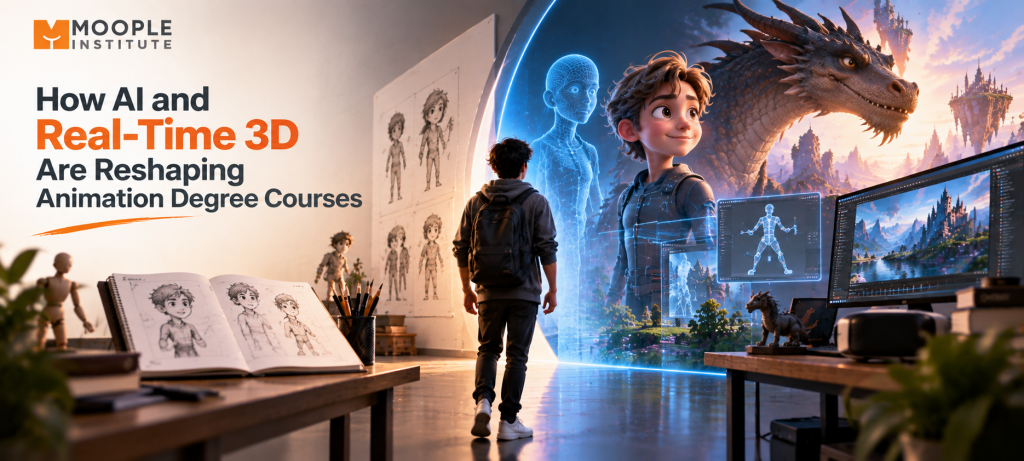
If you sat in an animation classroom five years ago, your syllabus probably revolved around frame-by-frame drawing, manual rigging, and render queues that took all night to finish a ten-second clip. Walk into a studio today and the workflow looks almost unrecognizable. Artists block out entire scenes in a game engine and see the final lighting instantly. AI tools generate rough in-betweens in seconds, freeing animators to focus on timing and emotion instead of repetitive cleanup.
This shift isn’t a passing trend. It’s a structural change in how animation is taught, produced, and hired for, and it’s exactly why animation degree courses are being redesigned around two forces: artificial intelligence and real-time 3D. Students who understand this shift early have a real advantage when they start applying for studio jobs, freelance projects, or their own creative ventures.
In this guide, we’ll break down what’s actually changing inside animation classrooms, which skills matter most for 2026 and beyond, and how to choose a program that keeps pace with the industry rather than teaching outdated pipelines.
Table of Contents
What’s Actually Changing in Animation Education
Animation schools have historically taught software first and problem-solving second. A student would learn Maya, then Toon Boom, then After Effects, in that order, and graduate with a portfolio built around whatever pipeline the school happened to use. That model is breaking down for a simple reason: pipelines themselves are changing faster than static syllabi can track.
Studios in Kolkata, Mumbai, and Bengaluru are increasingly building content directly inside real-time engines, using AI-assisted layout and cleanup tools to compress production timelines. A short that once took a twelve-person team three months might now be handled by a smaller team in six weeks, not because the artistry matters less, but because repetitive technical steps are automated.
For students, this means animation degree courses need to teach adaptable thinking, not just software shortcuts. A well-structured program still builds strong fundamentals in movement, weight, and storytelling, but it layers modern tools on top so graduates aren’t caught off guard on day one of a studio job.
Expert tip: When evaluating a course, ask how recently the software list and studio tools were updated. A curriculum that hasn’t changed in three years is a warning sign in an industry moving this fast.
AI in Animation: What It Replaces and What It Doesn’t
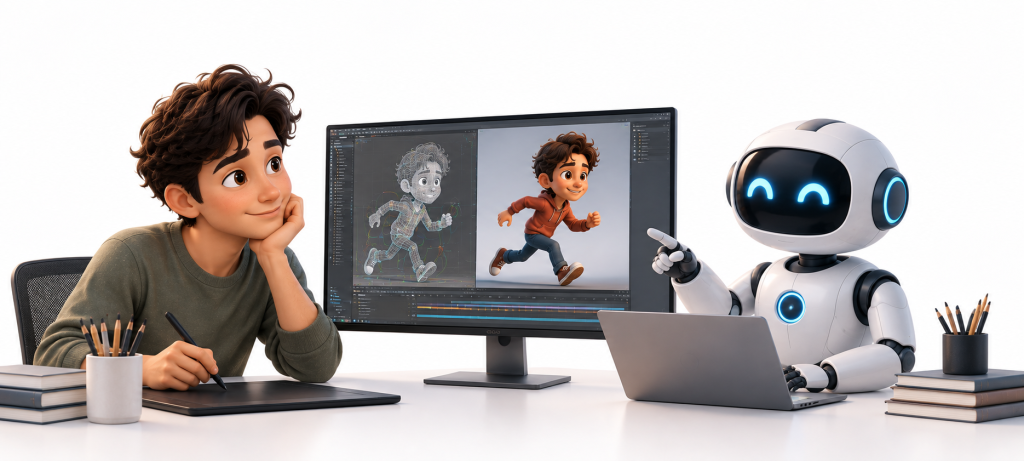
Quick definition: AI in animation refers to machine learning tools that assist with repetitive production tasks such as in-betweening, lip-sync generation, motion cleanup, and background generation, allowing animators to spend more time on creative decisions like timing, staging, and emotional performance.
There’s a lot of anxiety among new students about whether AI will replace animators altogether. The honest answer is more nuanced. AI is very good at:
- Generating rough in-between frames from key poses
- Auto-syncing lip movement to recorded dialogue
- Cleaning up motion capture data
- Speeding up rotoscoping and background painting
- Suggesting color palettes and lighting setups
What AI still struggles with is intent. It doesn’t understand why a character hesitates before a decision, or how a half-second pause changes the emotional read of a scene. That’s a human judgment call, built through years of studying acting, timing, and story structure. This is precisely why strong animation training still centers on the fundamentals of movement and storytelling, with AI tools taught as accelerators rather than replacements.
A common mistake students make is assuming that learning an AI tool is the same as learning animation. It isn’t. AI tools are only as good as the artistic decisions feeding into them. A student who understands the twelve principles of animation will get dramatically better results out of an AI in-betweening tool than one who doesn’t, because they know what a “good” in-between actually looks like.
Real-Time 3D: Why Game Engines Are Now Animation Tools
Real-time 3D refers to rendering technology, most commonly associated with engines like Unreal Engine and Unity, that displays final-quality visuals instantly rather than requiring hours of offline rendering. What started as game development technology is now core infrastructure for animated films, previsualization, virtual production, and architectural visualization.
The practical impact on animation training is significant. Instead of animating a scene and waiting overnight to see how the lighting and camera move actually look, students working in real-time engines see results immediately. That immediate feedback loop shortens the learning curve for cinematography, lighting, and blocking, because trial and error becomes cheap.
Real-time 3D also opens career paths that didn’t exist a decade ago: virtual production artist, real-time lighting technical director, and interactive experience designer, to name a few. Any modern animation training program that ignores real-time engines is preparing students for a job market that increasingly doesn’t exist in that form anymore.
Practical example: A student animating a walk cycle in a traditional offline-render pipeline might wait 20–40 minutes to preview a single lit shot. In a real-time engine, that same preview happens in under a second, allowing dozens of iterations in the time it used to take for one.
Traditional Pipeline vs. AI + Real-Time Pipeline
| Aspect | Traditional Pipeline | AI + Real-Time Pipeline |
|---|---|---|
| Render feedback | Minutes to hours per preview | Instant, real-time preview |
| In-betweening | Fully manual, frame by frame | AI-assisted with manual refinement |
| Lighting decisions | Finalized late in production | Tested and adjusted continuously |
| Team size for short projects | Larger teams, longer timelines | Smaller teams, compressed timelines |
| Required skill set | Software-specific technical skill | Cross-tool adaptability + fundamentals |
| Iteration speed | Slow, costly to change | Fast, low-cost experimentation |
| Entry-level job readiness | Narrow, single-pipeline knowledge | Broader, tool-agnostic problem solving |
This comparison isn’t meant to suggest traditional skills are obsolete. Every real-time and AI-assisted workflow still rests on the same animation fundamentals developed over the last century: timing, spacing, weight, and appeal. What’s changed is how quickly those fundamentals get translated into finished shots.
Skills Employers Actually Look For in 2026
Studios hiring junior animators today consistently mention a few recurring gaps in fresh graduates. Understanding these gaps is one of the most practical things a prospective student can do before choosing an animation institute.
- Strong fundamentals over flashy software knowledge. Recruiters can teach a new tool in a week; they can’t quickly teach timing and staging.
- Comfort with real-time engines, even at a basic level, since previsualization and virtual production work is expanding.
- Ability to direct AI tools effectively, meaning knowing what prompt, reference, or cleanup pass gets a usable result.
- A tight, focused demo reel rather than a long reel padded with unfinished work.
- Basic understanding of the production pipeline, so new hires can communicate with riggers, lighters, and editors without confusion.
A demo reel that shows a 12-second character performance with clear acting choices will consistently beat a 90-second reel of generic walk cycles, no matter how polished the software output looks.
👉 Explore More: Animation Courses with Job Placement: A Complete Guide for Students
What a Future-Ready Animation Degree Course Should Include
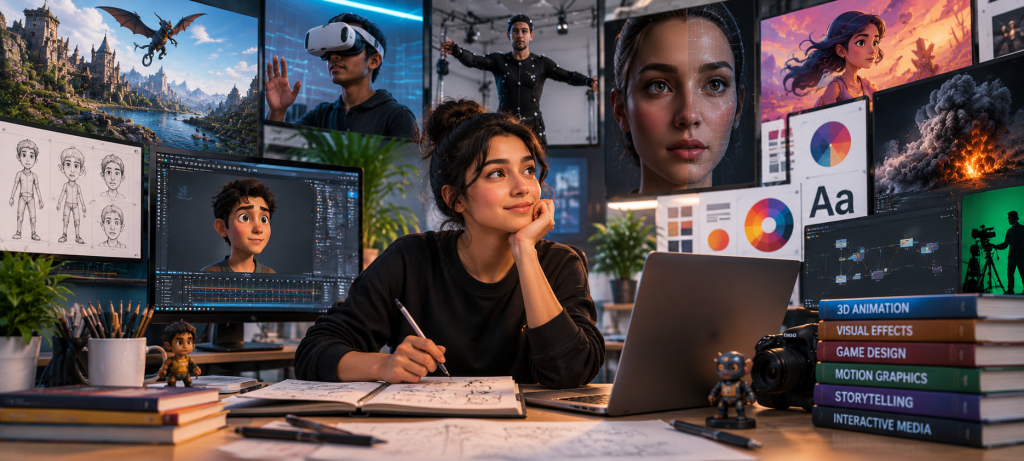
If you’re comparing animation degree courses, it helps to have a checklist rather than relying on marketing brochures alone. A genuinely future-ready program should combine classical training with current industry tools.
At minimum, look for coverage of:
- Foundational principles of animation and visual storytelling
- 2D and 3D animation software used in current studio pipelines
- Real-time engine exposure (Unreal Engine or Unity fundamentals)
- AI-assisted workflow training, taught alongside manual technique, not instead of it
- A structured portfolio-building process with industry feedback
- Internship or placement support connected to real studios
Programs like the Animation degree courses offered through structured BSc-level education are increasingly built around this blended model, combining classical animation training with exposure to the tools studios are actually using right now. This matters more than it might seem, because a degree that only teaches theory without current software fluency leaves graduates needing a second round of training before they’re employable.
Why Location-Specific Training Matters
Students often overlook how much local industry context matters. An Animation course in Kolkata that understands the regional job market, connects students with nearby studios, and structures placement support around the East India creative industry gives graduates a more direct path to work than a generic national curriculum with no local relationships.
Common Mistakes Students Make While Choosing a Course
Choosing the wrong animation training program is an expensive mistake, both in time and money. A few patterns show up repeatedly among students who later regret their choice:
- Picking a course based on software list alone, without checking whether fundamentals like storytelling and character acting are actually taught in depth.
- Ignoring placement support, then discovering after graduation that job search guidance was never part of the program.
- Assuming a longer course is automatically better, when in reality, curriculum quality and instructor experience matter more than duration.
- Overlooking real-time 3D exposure entirely, which leaves graduates unprepared for virtual production or game-adjacent animation roles.
- Comparing only tuition fees, without factoring in industry connections, mentorship quality, or the strength of the final portfolio produced.
Expert tip: Ask any institute you’re considering to show you recent student portfolios and, if possible, speak to a recent graduate about their actual placement experience. Marketing materials rarely tell the full story; alumni do.
How Moople Institute Is Adapting Its Animation Training
At Moople Institute, animation training is structured around this exact shift toward AI-assisted and real-time workflows, without dropping the classical fundamentals that make an animator employable in the first place. Students work through character performance, timing, and story fundamentals early, then layer in current industry tools including real-time engine basics and AI-assisted production techniques as they progress toward advanced coursework and their placement-ready portfolio.
The goal isn’t to chase every new tool the industry produces. It’s to make sure graduates leave with a demo reel and skill set that reflects how studios actually work today, not how they worked a decade ago.
Frequently Asked Questions
1. Will AI eventually replace animation jobs?
AI is more likely to change what animators spend their time on than eliminate the role entirely. Repetitive technical work is being automated, while creative decision-making, storytelling, and character performance remain distinctly human skills.
2. Do I need to know coding to work with real-time engines like Unreal Engine?
Basic scripting knowledge helps but isn’t mandatory for most animation-focused roles. Many real-time engine tasks used in animation production rely on visual scripting tools rather than traditional programming.
3. Is a BSc in Animation still valuable if AI tools can generate content quickly?
Yes. Structured degree programs teach the fundamentals that make AI-generated content usable and polished. Without training in timing, composition, and storytelling, AI output tends to look generic and unconvincing.
4. How long does it typically take to build a job-ready animation portfolio?
Most focused animation degree programs, combined with dedicated portfolio work, take between two and three years to produce a reel strong enough for entry-level studio applications, though timelines vary by individual effort and mentorship quality.
5. What’s the difference between animation training and an animation degree course?
Short-term training programs typically focus on specific software skills over a few months, while a full degree course builds broader foundational knowledge across storytelling, design theory, and production pipelines, generally making graduates more versatile for long-term career growth.
6. Are there placement-focused animation courses available in Kolkata?
Yes, several institutes in Kolkata now offer animation courses with structured placement support, including portfolio reviews, studio partnerships, and interview preparation tailored to the regional job market.
Conclusion
AI and real-time 3D aren’t replacing the artistry behind animation; they’re changing how quickly and efficiently that artistry gets produced. Studios are hiring graduates who understand both the timeless fundamentals of movement and storytelling and the current tools reshaping production pipelines. Choosing a program like Moople Institute that teaches both sides of that equation, rather than one at the expense of the other, puts students in a far stronger position when they enter the job market.
The animation industry has always rewarded artists who adapt without losing sight of craft. That’s exactly what a well-built animation degree course should be teaching in 2026 and beyond.