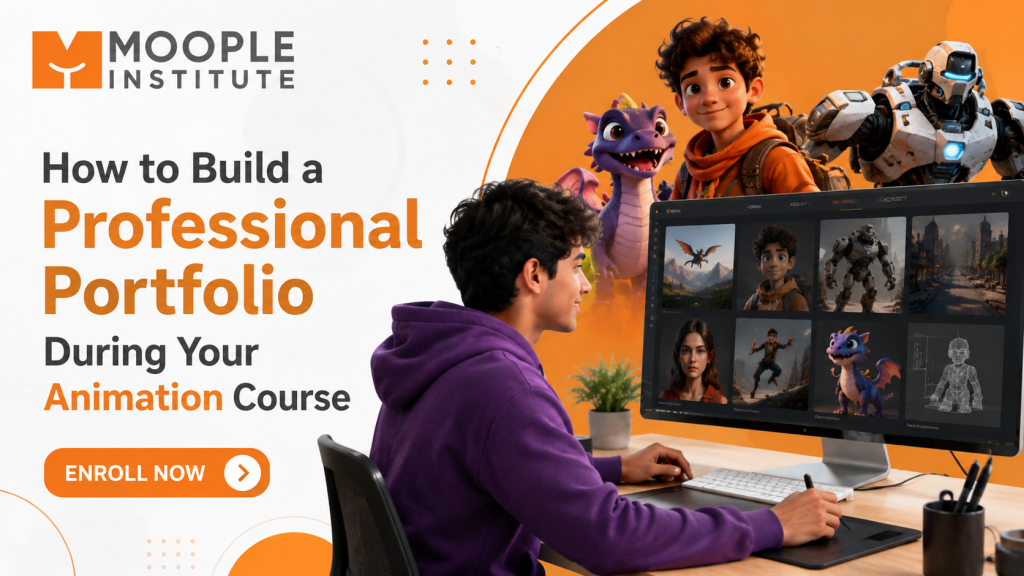
Every recruiter at an animation or VFX studio asks the same unspoken question before they ask anything else: can this person actually animate? Your degree tells them you studied. Your resume tells them what software you’ve touched. But it’s your portfolio that answers the real question — and it’s the only part of your application a studio genuinely cares about.
If you’re enrolled in, or considering, an animation course, the biggest mistake you can make is waiting until graduation to start building your portfolio. A strong portfolio isn’t something you assemble in the last month of your course. It’s something you grow, piece by piece, from week one — shaped by every assignment, every critique, and every late night spent fixing a walk cycle that just wouldn’t look right.
This guide walks you through exactly how to build a professional animation portfolio while you’re still studying, so that by the time you graduate, you’re not scrambling to create one — you’re simply polishing what you’ve already built. We’ll cover what studios actually look for, how to choose your niche, which projects to include (and which to leave out), common mistakes students make, and practical tools you can start using today.
Table of Contents
What Is an Animation Portfolio, and Why Does It Matter More Than Your Degree?
An animation portfolio is a curated collection of your best animation, design, or VFX work — usually presented as a demo reel, website, or online profile — that demonstrates your technical skill, creative judgment, and readiness to work on real production tasks.
Unlike a resume, which lists what you’ve done, a portfolio shows what you can do. Studios in India and abroad routinely skip resumes altogether during early screening and go straight to the reel. If the first ten seconds don’t show competent, appealing motion, most recruiters move on. That’s not a reason to panic — it’s a reason to start early and be deliberate about what goes into your reel.
This is also why an animation degree course is only half the equation. The certificate proves you completed structured training. The portfolio proves you can apply it.
When Should You Start Building Your Portfolio?
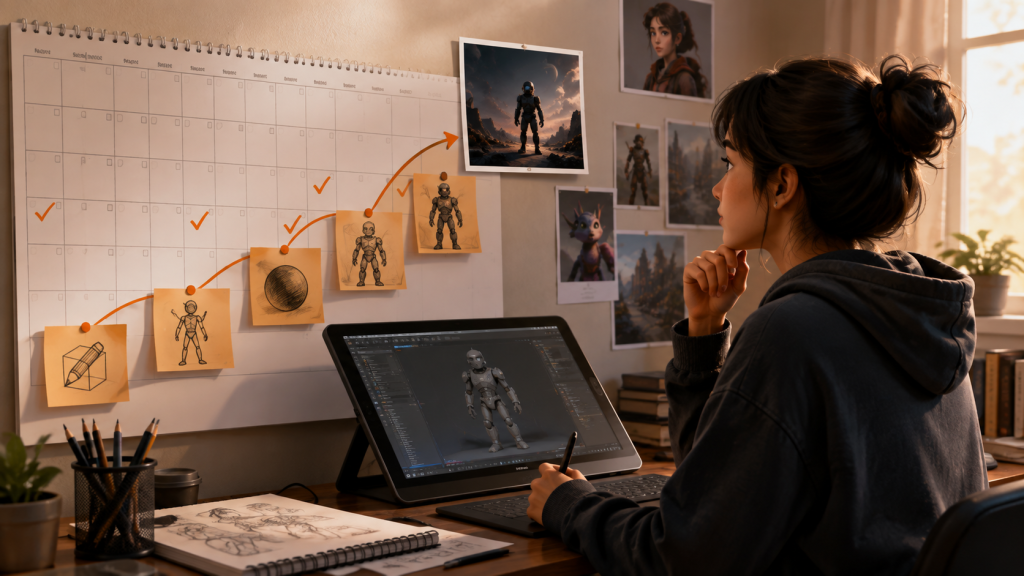
The honest answer: from your very first month of animation training.
Most students treat early assignments — a bouncing ball, a simple walk cycle, a basic character rig — as throwaway practice. That’s a missed opportunity. Even a well-executed bouncing ball, with proper timing and squash-and-stretch, can become a small but respectable portfolio piece if you polish it after the class deadline rather than abandoning it once it’s graded.
Think of your course as a timeline with three portfolio phases:
- Foundation phase (months 1–4): Focus on fundamentals — timing, spacing, weight, basic rigging. Keep the strongest exercises; don’t include weak ones just to fill space.
- Skill-building phase (months 5–10): Start specializing. This is where character animation, 3D modeling, VFX compositing, or motion graphics work begins to look genuinely portfolio-ready.
- Production phase (final months): Work on 1–2 substantial pieces — a short film, a demo reel sequence, or a client-style project — that pull together everything you’ve learned.
Starting early also gives you time to redo weak shots. Nobody’s first attempt at a run cycle is reel-worthy. Students who begin early have the luxury of revisiting and improving old work before graduation; students who wait have to submit whatever they managed to finish in a rush.
Step 1: Choose a Niche Before You Try to Do Everything
A portfolio that tries to prove you can do 2D, 3D, VFX, motion graphics, and game animation equally well usually proves the opposite — that you haven’t gone deep enough in any one of them. Studios hire specialists far more often than generalists, especially at entry level.
During your animation class, pay attention to which discipline consistently excites you and which one you’re naturally better at:
- Character animation — if you love performance, acting, and bringing personality to movement.
- 3D modeling and texturing — if you enjoy sculpting form and building assets.
- VFX and compositing — if simulations, particles, and integrating CG into live footage appeal to you.
- Motion graphics — if you’re drawn to typography, branding, and design-led animation.
You don’t need to abandon everything else — a well-rounded skill set is valuable — but your portfolio should have a clear center of gravity. Recruiters should be able to describe what you do in one sentence after watching your reel.
👉 Know More: How to Choose the Right Animation Course in Kolkata After 12th
Step 2: Turn Classroom Assignments Into Portfolio-Worthy Work
Not every classroom exercise deserves a spot in your final reel, but almost every exercise can be upgraded into something that does.
Here’s a practical approach:
- Revisit graded work after feedback. Your instructor’s notes are the fastest way to identify what’s holding a shot back. Fix it before moving on.
- Push polish beyond the assignment brief. If the brief asked for a basic walk cycle, add secondary motion, better arcs, or refined timing once the grade is in.
- Re-light or re-render 3D work. Sometimes a shot fails to impress simply because of flat lighting or a rushed render — not because the animation itself is weak.
- Add sound design. A silent reel feels unfinished. Even simple foley or ambient sound instantly makes a shot feel more professional.
This habit — treating coursework as raw material rather than a finished product — is what separates students who graduate with a strong reel from students who graduate with a folder of assignments.
Step 3: Build Personal Projects Alongside Your Coursework
Classroom assignments prove you can follow a brief. Personal projects prove you can generate ideas, solve problems independently, and finish what you start — a quality studios value enormously, because unfinished personal work is one of the most common red flags on a junior portfolio.
Good personal project ideas for students in an animation training program include:
- A 15–30 second character performance piece showing emotion or personality.
- A short environment or prop showcase if you’re focused on modeling.
- A one-minute mock advertisement combining motion graphics and sound.
- A VFX breakdown video showing before/after compositing work.
Keep personal projects small and finishable. A 10-second polished piece will always outperform a 3-minute unfinished short film in a recruiter’s eyes.
Step 4: Get Feedback Early and Often
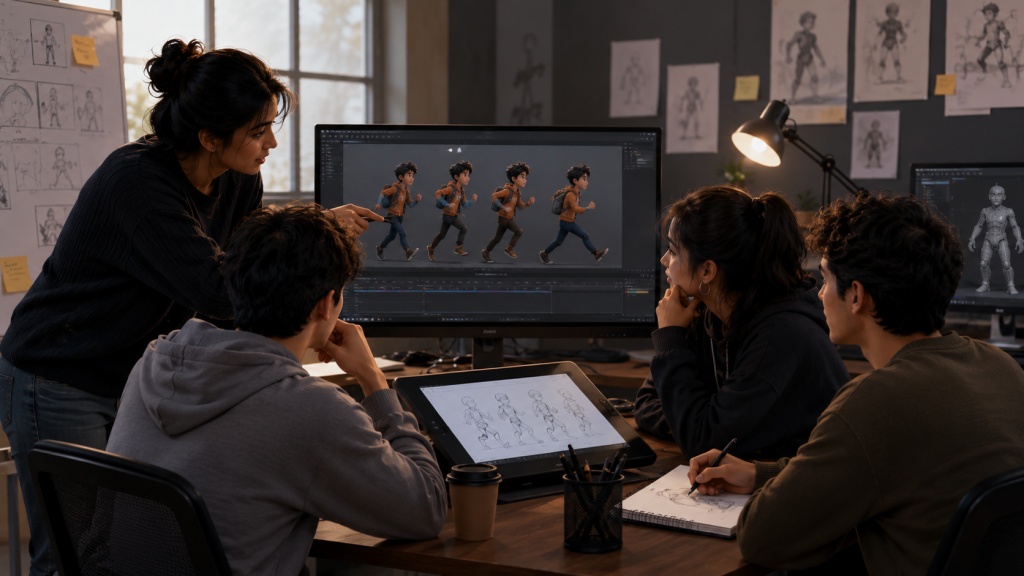
Self-assessment has a blind spot: you already know what you meant to animate, so your brain fills in gaps that a stranger’s eye will immediately catch. This is why regular, structured feedback is non-negotiable.
Useful sources of feedback during your course include:
- Instructor critiques — the most valuable, since they understand industry expectations.
- Peer reviews — classmates often catch timing issues you’ve become blind to.
- Online animation communities — forums and Discord groups dedicated to animation critique.
- Recorded playback and mirror tests — for 2D and character animators, comparing your animation to reference footage of yourself performing the action.
A useful habit: watch your own shot with the sound off and ask whether the story or emotion still reads clearly. If it doesn’t, the issue is usually in the acting or timing, not the technical execution.
Step 5: Curate Ruthlessly — Quality Over Quantity
This is the step most students get wrong. A portfolio with 25 mediocre pieces will always lose to one with 6 excellent ones. Recruiters and studio leads typically spend very little time on an initial reel viewing, so your strongest work needs to appear first — and everything after it needs to earn its place.
A simple curation test: for every piece you’re considering, ask “does this show a skill the rest of my portfolio doesn’t already demonstrate better?” If the answer is no, cut it.
Comparison Table — What to Keep vs. What to Cut
| Criteria | Keep in Portfolio | Cut from Portfolio |
| Skill level | Your strongest, most polished work | Early practice exercises with visible flaws |
| Uniqueness | Pieces that show a distinct skill (rigging, lighting, acting) | Repeats of a skill you’ve already demonstrated |
| Completion | Fully finished shots with sound and polish | Half-finished or unrendered work |
| Relevance | Work matching your chosen niche | Unrelated experiments outside your focus area |
| Feedback | Pieces revised after critique | Unrevised first drafts |
Step 6: Package Your Work Like a Professional
Even excellent animation can be undersold by poor presentation. A few production details make a measurable difference:
- Keep your reel under 90 seconds unless you’re applying for a role that specifically requests longer samples.
- Put your best shot first and your second-best shot last — recruiters remember beginnings and endings most.
- Label your reel clearly with your name, role focus (e.g., “Character Animator”), and contact details in the opening and closing frames.
- Add a shot breakdown in the video description if you contributed to only part of a shot — for example, noting “rigging and animation only; modeling by [collaborator].”
- Export in a widely compatible format (MP4, H.264) at consistent resolution and frame rate.
Tools and Platforms to Showcase Your Portfolio
Where you host your portfolio matters almost as much as what’s in it. Consider using a combination of:
- ArtStation — the industry standard for 2D, 3D, and concept art portfolios.
- YouTube or Vimeo — for hosting your demo reel with clean, unlisted or public links.
- LinkedIn — to attach your reel to a professional profile recruiters actively search.
- A personal website — gives you full control over layout and lets you include a resume, case studies, and process breakdowns alongside your reel.
Using more than one platform isn’t redundant — it increases the chances a recruiter finds you through their preferred channel.
Common Mistakes Students Make With Their Portfolios
- Waiting until the final semester to start. This leads to rushed, underdeveloped work.
- Including everything instead of curating. Volume doesn’t impress; consistency does.
- Ignoring sound design. Silent reels feel unfinished even when the animation itself is strong.
- Ghosting on process. Not showing any rough blocking, sketches, or wireframes makes it harder for studios to judge your workflow and problem-solving.
- Copying tutorial projects without modification. Recruiters can often recognize popular tutorial rigs and scenes; unmodified tutorial work signals a lack of original thinking.
- No clear specialization. A scattered reel with a little of everything rarely convinces a studio you’re ready for a specific role.
- Poor file management. Broken links, outdated reels, or portfolios that haven’t been updated in over a year all cost you opportunities.
Portfolio Formats Compared: Reel vs. Website vs. Social Platform
| Format | Best For | Pros | Cons |
| Demo Reel (video) | Character animation, VFX, motion graphics | Fast to review, industry standard, easy to share | Limited context per shot |
| Personal Website | Multi-discipline artists, freelancers | Full control, case studies, resume integration | Requires setup and maintenance |
| ArtStation / Social Platform | 2D/3D artists, concept work | High visibility, built-in recruiter traffic | Less control over layout |
Most professionals use a combination: a reel as the core showcase, backed by a website or ArtStation profile for depth.
Expert Tips From Industry Mentors
- “Show your weakest strong shot, not your strongest weak shot.” A mid-level piece that’s fully polished beats an ambitious piece that’s clearly unfinished.
- Treat every submission as a job application, even during your course. The habits you build now — labeling files properly, meeting deadlines, presenting work cleanly — carry directly into your first studio job.
- Study the reels of working professionals in your chosen niche, not just fellow students, to calibrate what “industry-ready” actually looks like.
- Don’t wait for perfection to publish. An 80%-polished reel that’s out there getting seen is more valuable than a 100%-polished reel sitting unfinished on your hard drive for another six months.
How Moople Institute Helps Students Build Their Portfolio
At Moople Institute, portfolio-building isn’t treated as an afterthought tacked on at the end of the course — it’s built into the structure of the animation course in Kolkata from day one. Students receive structured critique sessions, industry-mentor feedback, and guided project briefs designed specifically to be reel-ready, not just classroom-ready.
For students in Kolkata comparing options, this hands-on, portfolio-first approach is one of the key differences between a general animation institute and one built around actual industry placement outcomes. Whether you’re exploring a short-term animation training classes format or a full animation degree course, the goal at every stage is the same: leave with a portfolio that gets you interviews, not just a certificate that sits in a drawer.
India’s animation and VFX sector is also growing fast — industry estimates from a CII GT report suggest the segment could expand from roughly USD 1.3 billion in 2023 to around USD 2.2 billion by 2026, with tens of thousands of new jobs opening up across the country each year. That growth means more opportunities, but also more competition — which makes a strong, well-timed portfolio more important than ever for students entering the field from cities like Kolkata.
Frequently Asked Questions
Q1. How many pieces should be in an animation portfolio?
Most professional reels run 6–10 shots, totaling 60–90 seconds. Focus on quality and variety within your niche rather than a specific count.
Q2. Can I get a job with only student projects in my portfolio?
Yes. Studios expect entry-level portfolios to be built primarily from coursework and personal projects. What matters is polish, consistency, and evidence of independent problem-solving — not prior professional credits.
Q3. Should my portfolio include unfinished work?
Generally no. If you want to show process, use a separate “breakdown” section or behind-the-scenes reel rather than mixing unfinished shots into your main showcase.
Q4. How often should I update my portfolio during my course?
Review and refresh it every 2–3 months. Replace weaker early pieces as stronger, more recent work becomes available.
Q5. Do I need a personal website, or is a demo reel enough?
A demo reel is the essential core. A website or ArtStation profile adds depth and is especially useful if you’re applying to multiple studios or freelancing, since it lets recruiters explore your process beyond the reel.
Q6. What software skills should I highlight alongside my portfolio?
List the tools you used for each piece (e.g., Maya, Blender, Toon Boom Harmony, After Effects, Nuke) directly in your reel description or resume, so recruiters can match your skills to their pipeline.
Conclusion
Building a professional animation portfolio isn’t a final-semester scramble — it’s a habit you develop across your entire course. Start early, pick a niche, treat classroom work as raw material rather than a finished product, seek feedback constantly, and curate with discipline. By graduation, you won’t be building a portfolio from scratch; you’ll simply be selecting the best of what you’ve already made.
If you’re ready to start building a portfolio that actually gets you interviews, explore Moople Institute‘s animation course in Kolkata or browse our full range of animation degree courses. Our mentors work with you from your very first assignment to your final showreel — so when you graduate, you’re not just certified, you’re ready to work.